For years, the visibility question was simple: how do I rank on Google?Today, customers also open ChatGPT and ask, "Which is the best option for me?" They get one conversational answer instead of ten blue links.
Now there is a second question: should you pay for visibility inside ChatGPT, or earn it through AEO and GEO?
The short answer is that they are different tools solving different problems. Here is how each works, and how to use them together.
What Are ChatGPT Ads?
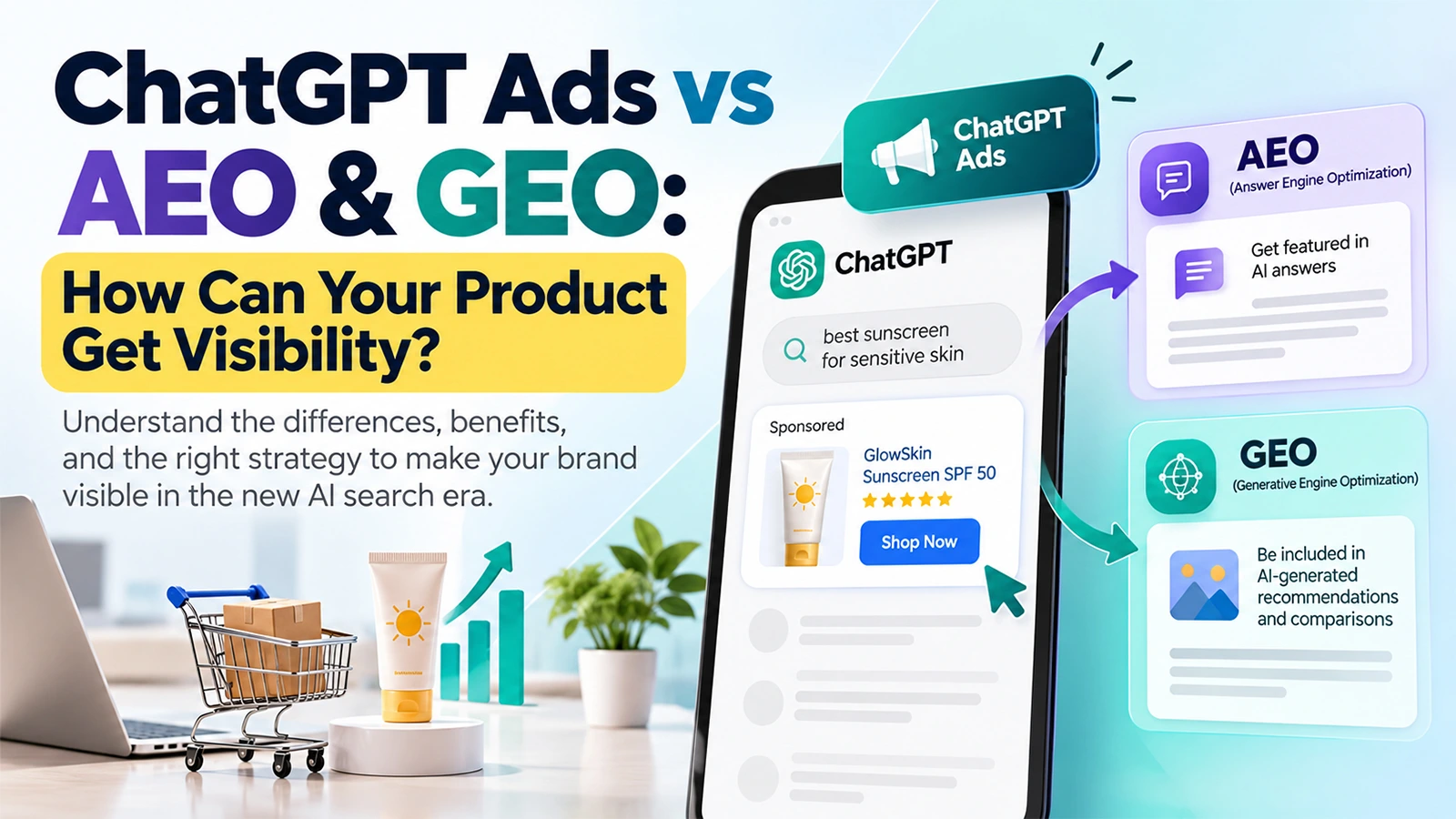
ChatGPT Ads are paid placements inside ChatGPT. Logged-in users on the Free and Go tiers see sponsored ads for products or services at the bottom of responses, clearly labelled and visually separated from ChatGPT's answers.
The rollout has moved quickly. Advertising began in the United States in February 2026, and OpenAI has since expanded ChatGPT Ads to India, its second-largest market. Self-serve access to ChatGPT Ads Manager was announced for September 4, with daily budgets starting at Rs 725.
Two points matter for marketers:
- Ads are separate from the answer. OpenAI says advertisers cannot see users' chats, chat history, memories, or personal details, and that it does not sell user data. Advertisers only receive aggregate data like impressions and clicks.
- Ads don't buy you a recommendation. OpenAI states that ads will not affect ChatGPT's responses. Paying puts you in a labelled sponsored slot. It does not make ChatGPT recommend you in the answer itself.
Ad availability, formats, and pricing are still evolving, so confirm current details in OpenAI's Ads Manager before planning a budget.
What Are AEO and GEO?
Answer Engine Optimization (AEO) structures your content so that answer-driven platforms can easily find and understand direct answers to customer questions.
Generative Engine Optimization (GEO) builds the wider ecosystem of expertise, product information, reviews, third-party mentions, structured data, and consistent brand details. That ecosystem helps generative AI tools understand and potentially reference your brand.
Neither can be switched on with a budget, and neither is guaranteed. They are organic efforts that build credibility over time.
ChatGPT Ads vs AEO & GEO: Side-by-Side
| ChatGPT Ads | AEO & GEO | |
|---|---|---|
| Type of visibility | Paid, labelled as sponsored | Organic, earned |
| Where it appears | Below ChatGPT's answer | Within answers, citations and AI-driven discovery (not guaranteed) |
| Speed | Can start once campaigns are live | Builds over weeks and months |
| Cost model | Ongoing ad spend | Investment in content, technical work and authority |
| Longevity | Stops when the budget stops | Compounds over time |
| Control | You control targeting, budget and creative | You influence it but cannot control it |
| Trust factor | Seen as advertising | Seen as information |
| Audience reach | Free and Go users only | Wider search and AI ecosystem |
When Do ChatGPT Ads Make Sense?
Paid visibility works well when you need:
- A product launch push with a defined timeline
- Seasonal or festival campaigns where speed matters
- Testing demand for a new offering before investing in content
- Capturing high-intent moments when a customer is actively comparing options
Remember the audience limit. Ads are shown to Free and Go users, so subscribers on higher plans won't see them.
When Do AEO and GEO Matter More?
Organic AI visibility is the stronger long-term play when you want to:
- Become a trusted source in your category, not just a paid presence
- Be understood consistently across ChatGPT, Google, voice assistants and other AI tools
- Reduce dependence on ad spend
- Build credibility that supports every other channel
Customers tend to trust answers more than advertisements. A brand that is clearly explained, well referenced, and consistently described across the web is easier for AI systems to interpret and for customers to believe.
How to Build AEO & GEO Visibility
There is no trick that forces an AI tool to recommend you. These foundations help:
- Write strong product and service pages. Be clear about what you offer, who it is for, pricing context, specifications, and FAQs.
- Answer real customer questions. Build content around conversational queries, not just short keywords.
- Build topical depth.Create topic clusters instead of isolated articles.
- Use structured data.Mark up products, organizations, reviews, and FAQs where appropriate. It helps machines interpret your pages, though it is not a guarantee of AI mentions.
- Keep your brand information consistent.Names, addresses, features and descriptions should match across your website, business profiles and directories.
- Earn third-party mentions.Genuine reviews, expert contributions, industry coverage and digital PR strengthen credibility.
- Fix the technical basics.Crawlability, speed, mobile experience and clean architecture still matter.
- Avoid manipulation.Keyword stuffing and fake reviews damage trust. Aim for useful, honest, expert content.
The Smart Strategy: Use Both
This is not an either-or decision. A balanced approach looks like this:
- Short term: Use ChatGPT Ads (and other paid channels) to capture demand quickly and learn which messages convert.
- Long term: Invest in AEO and GEO so your brand is understood and trusted wherever customers search.
- Connect the two: Use what you learn from ad performance, such as which questions and messages perform, to shape your AEO content.
- Measure both: Track enquiries, branded searches, referral traffic, and how your brand appears across AI and search experiences.
Think of ads as renting attention and AEO and GEO as owning it.
Example: A Chennai Business Planning for AI Visibility
Imagine a Chennai real estate developer. A buyer might ask an AI tool,"Which areas in Chennai are good for 2BHK apartments near IT corridors under a certain budget?"
- Paid: A sponsored ad could appear beneath the answer to drive enquiries during a project launch.
- Organic: Detailed locality guides, project pages with clear specifications, FAQs on buying and loans, consistent business listings, and credible third-party mentions help the brand become a trustworthy source over time.
The developer who does both captures immediate leads and builds an asset that keeps working.
How Yung Media Can Help
At Yung Media, a digital marketing agency in Chennai, we help brands plan for visibility across traditional search, AI-powered answers, and paid media. Our work includes:
- SEO audits and technical SEO
- Keyword and conversational search-intent research
- AEO content and FAQ strategy
- GEO optimization and brand entity building
- Structured data implementation
- Oct Digital PR and third-party authority building
- Local SEO
- Performance tracking and reporting
We don't promise guaranteed placement in any AI answer, because no one can. What we build is a stronger, clearer, and more credible digital presence, backed by a strategy that balances paid and organic visibility.
Final Takeaway
ChatGPT Ads give you reach when you pay. AEO and GEO give you credibility that lasts.
The brands that win in the next phase of search will not choose one over the other. They will pair paid visibility with an organic foundation that makes them easy to discover, understand, and trust.
Ready to prepare your brand for AI search? Talk to Yung Media for an AEO and GEO strategy tailored to your business.
Can I pay ChatGPT to recommend my product?
No. Ads are labelled as sponsored and appear separately, and OpenAI says they do not influence the answers.
Who sees ChatGPT Ads?
Reports say logged-in adults on the Free and Go tiers in supported markets, including India.
Is AEO the same as GEO?
They overlap but differ. AEO focuses on clear, direct answers to questions. GEO focuses on brand information, authority, and credibility across the web for generative AI.
How long do AEO and GEO take to show results?
They are gradual. Expect weeks to months of consistent work, and results are never guaranteed.
Should I stop SEO if I run ChatGPT Ads?
No. SEO supports AEO and GEO, and your website remains the destination for both paid and organic visibility.