

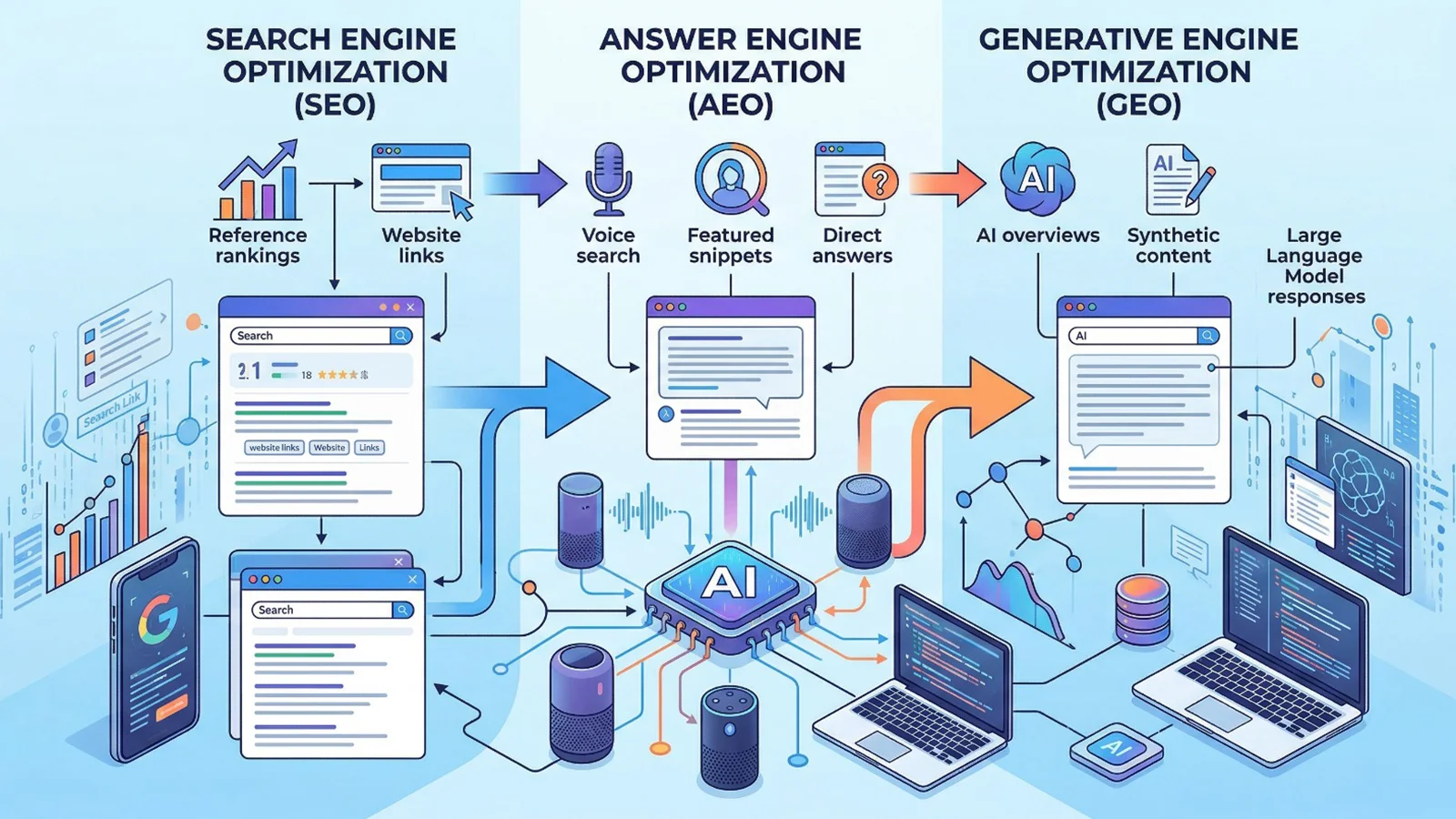
Search Engine Optimization has entered a new era. In 2026, Artificial Intelligence is no longer just influencing search; it is fundamentally reshaping how search engines understand, rank, and deliver content to users. For businesses still relying on traditional SEO methods, the message is clear: adapt now or fall behind.
What Has Actually Changed?
A few years ago, SEO was largely a game of keywords, backlinks, and technical checkboxes. Today, search engines powered by AI can interpret user intent, grasp contextual meaning, analyse cross-device behaviour patterns, and respond to real-time engagement signals all simultaneously.
The evolution looks like this: keyword-focused strategies gave way to intent-focused ones, which are now giving way to something deeper, experience-driven search. If your content doesn't genuinely serve the user, no amount of optimisation will keep you visible.
1. Intent Now Matters More Than Keywords
AI algorithms have moved well beyond matching search terms to page content. They now evaluate why someone is searching, and your content is judged on how well it addresses that underlying need.
If someone searches "best SEO services in Chennai," the algorithm doesn't just look for pages that use that phrase. It considers what the user actually wants: are they comparing agencies? Researching pricing? Looking for a consultation? Content that answers the real question with depth and relevance consistently outperforms content that merely repeats the keyword.
2. The Rise of Answer Engine Optimisation (AEO)
Search engines are increasingly behaving like answer engines. Users today expect immediate, direct responses, not ten blue links to scroll through. Featured snippets, knowledge panels, and voice search results have all become prime digital real estate.
This shift has given rise to AEO, or Answer Engine Optimisation. To win in this space, content needs to be structured clearly, written conversationally, and supported by schema markup and FAQ sections. Businesses looking to capture voice search and zero-click results must think about how their content sounds as an answer, not just how it reads as an article.
3. Generative Engine Optimisation (GEO) Is the Next Frontier
With AI tools like ChatGPT and Google's Search Generative Experience (SGE) now delivering synthesised answers directly to users, visibility has expanded beyond traditional search rankings. Users are increasingly getting what they need without ever clicking through to a website.
This introduces GEO Generative Engine Optimisation. It means structuring your content so that AI systems can accurately summarise and cite it, building the kind of topical authority and trust signals that earn you a place in AI-generated responses. SEO in 2026 is not just about Google page one; it's about showing up wherever AI answers live.
4. AI Tools Have Transformed Content Strategy
The content planning process has been completely reshaped by AI. Keyword clustering, content gap analysis, competitor benchmarking, and readability scoring can now all be done at scale and speed that wasn't possible before.
But here's the important nuance: AI-generated content on its own does not rank. Google continues to reward genuine expertise, original insights, and what it calls E-E-A-T Experience, Expertise, Authoritativeness, and Trustworthiness. The businesses seeing results are those combining AI efficiency with human strategic thinking using AI to scale, not to replace judgment.
5. Technical SEO Has Become Faster and Smarter
AI has made technical audits significantly more powerful. Crawl issues that once took days to surface are now flagged instantly. Page speed bottlenecks, Core Web Vitals failures, and indexing problems can be identified and prioritised automatically.
This doesn't make technical SEO less important; it makes it more important to get it right. AI tools surface the problems; skilled professionals still need to know what to do with that information.
6. Voice Search, Visual Search, and Personalisation Are Growing
Two search behaviours that were niche a few years ago have now gone mainstream. Voice search through Google Assistant, Alexa, and similar tools requires conversational, question-based content optimised for how people speak, not just how they type. Visual search through Google Lens is transforming how users discover products, places, and brands through images.
At the same time, search results are increasingly personalised. What appears for one user in Chennai may differ significantly from results served to another based on their location, device, search history, and online behaviour. A one-size-fits-all SEO strategy simply cannot keep up with this level of personalisation.
Common Mistakes to Avoid
Many businesses are still operating on outdated assumptions. The most common pitfalls right now: fixating on keyword density rather than intent, publishing AI-generated content without editorial strategy, ignoring AEO and GEO entirely, neglecting technical SEO fundamentals, and treating SEO as a one-time setup rather than an ongoing process.
What the Future of SEO Looks Like
The direction is clear. SEO is becoming AI-driven, intent-focused, experience-based, and multi-platform. Businesses that invest in understanding these shifts early and build content and technical strategies around them will be the ones dominating search visibility over the next few years.
AI is not replacing SEO. It is redefining what good SEO looks like.
Work With an AI-Powered SEO Agency in Chennai
At Yung Media, we help businesses navigate this new landscape with advanced SEO services powered by AI, data, and deep strategic thinking. As specialists in AEO and GEO, we focus on what actually moves the needle: higher rankings, stronger authority, and sustainable organic growth.
If you're ready to build a search strategy that works in 2026 and beyond, connect with Yung Media, your trusted AI-powered SEO partner in Chennai.