

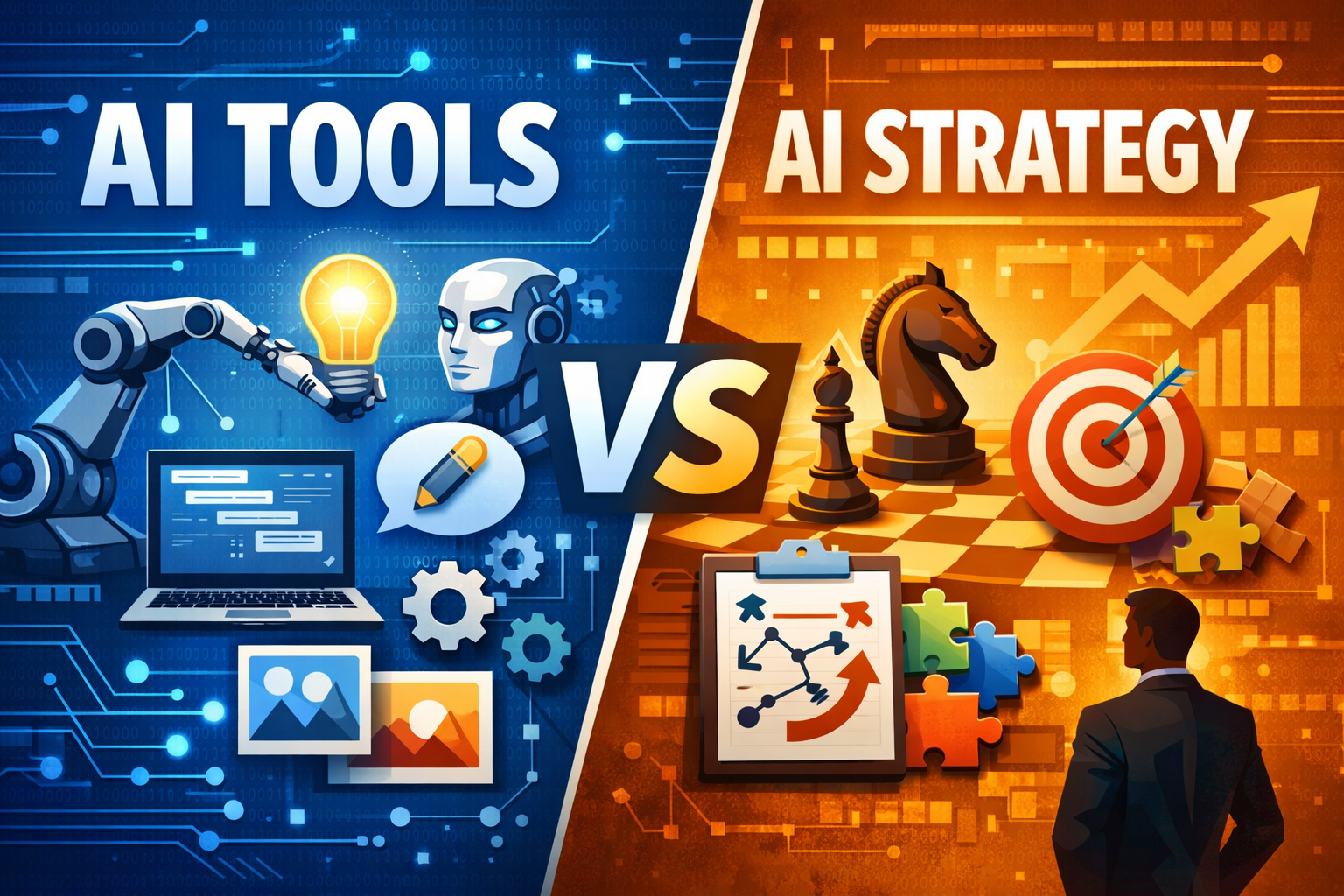
Every week, a new AI tool promises to revolutionise your business. ChatGPT for copy. Midjourney for visuals. HubSpot AI for CRM. The list grows daily. But here`s what most businesses get dangerously wrong: buying tools is not the same as having a strategy. And that confusion is costing companies real money.
The Tool Trap
Imagine hiring a team of elite chefs but giving them no menu, no kitchen workflow, and no idea who the restaurant serves. They each cook brilliantly, but what comes out is chaos. That`s exactly what happens when businesses stack AI tools without a strategic foundation.
AI tools are tactical. They execute specific tasks: writing, scheduling, analysing data, and generating images. They are incredibly powerful in isolation. Power alone means little if it lacks direction.
Buying AI tools without a strategy is like installing solar panels before you`ve decided what you want to power.
So What`s the Difference?
AI TOOLS — What You Buy
- Solves a single task
- Vendor-driven, plug & play
- Measured by features
- Works in isolation
- Can be replaced overnight
- Reactive to your workflow
AI STRATEGY — What You Build
- Solves business problems
- Goal-driven, custom-designed
- Measured by outcomes
- Integrates across teams
- Compounds in value over time
- Proactive to your goals
Why Businesses Keep Getting This Wrong
1. FOMO Spending The AI hype cycle moves fast. Businesses see competitors posting about their AI stack and panic-buy subscriptions to stay competitive. The result? A graveyard of unused SaaS tools and a team that`s more confused than empowered.
2. No Clear Ownership When AI tools are adopted without a strategy, nobody owns the outcome. Marketing uses one tool. Sales uses another. Operations uses a third. They never talk to each other, nor do the data they generate.
3. Measuring the Wrong Things Businesses celebrate "we use 12 AI tools" as a success metric. But the real questions are: Has customer acquisition cost dropped? Are conversion rates improving? Is your team spending less time on low-value tasks? Tools are means. Results are the measure.
By the Numbers
- 73% of AI tool investments fail to deliver measurable ROI
- 4.2× more revenue growth for companies with a defined AI strategy
- 60% of AI tools go unused within 90 days of purchase
What an AI Strategy Actually Looks Like
A proper AI strategy starts with your business objectives — not a product catalogue. It asks: where are we losing time, money, or customers? Then it maps the right tools and workflows to those specific friction points.
01 — Audit Your Current Operations: Identify where time is wasted, where decisions are slow, and where your team is doing repetitive manual work. These are your AI opportunity zones.
02 — Define Success Metrics First. Before selecting any tool, define what winning looks like. Faster lead response? Lower content production cost? Higher email open rates? Metrics drive tool selection — not the reverse.
03 — Build an Integrated Stack — Not a Collection. Your AI tools should pass data to each other, inform each other, and create compounding feedback loops. A disconnected stack is just digital clutter.
04 — Train Your People, Not Just Your Prompts. AI amplifies human decisions. If your team doesn`t understand how or why to use AI tools within your strategy, even the best tech will underperform.
05 — Review, Iterate, and Optimize. An AI strategy requires continuous monitoring, refinement, and improvement. Set quarterly review cycles to assess what`s working, cut what isn`t, and double down on what`s delivering results.
The Marketing Angle: Where This Matters Most
For digital marketing specifically, the tools vs. strategy gap is most costly. Brands invest in AI copywriting tools but have no brand voice guidelines for the AI to follow. They use AI for paid ad creative, but have no testing framework to know which variants win. They automate email sequences without mapping the customer journey they`re trying to accelerate.
A great AI marketing strategy doesn`t just produce content faster; it builds a system that learns your audience, optimises in real time, and frees your team to focus on creativity and relationships.
The businesses winning with AI aren`t the ones with the most tools. They`re the ones with the clearest thinking.
The Bottom Line
AI tools are commodities. Within 18 months, every competitor you have will access the same tools at similar price points. The unique way you apply, integrate, and optimise AI for your specific business is your real competitive advantage.
Stop asking "which AI tool should we buy next?" Start asking "what business outcome are we trying to achieve, and how does AI get us there faster?"
That shift in thinking is worth more than any software subscription.
Ready to stop guessing?
At Yung Media, we don`t sell you tools; we build you systems. Our team designs custom AI-powered marketing strategies that align with your goals, your audience, and your growth targets.
Book a free strategy session and find out exactly where AI can move the needle for your business.
No commitment. No jargon. Just clarity on your next move.
Yung Media — Digital Marketing · AI Strategy · Growth Systems